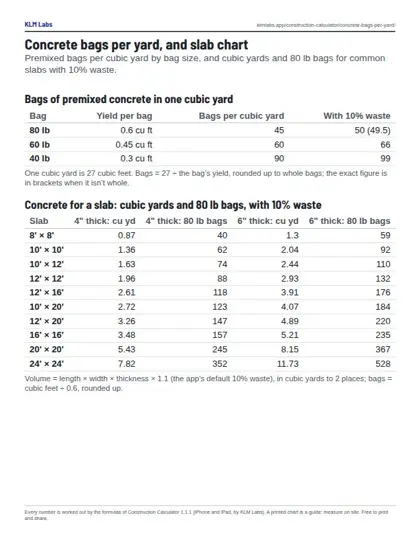
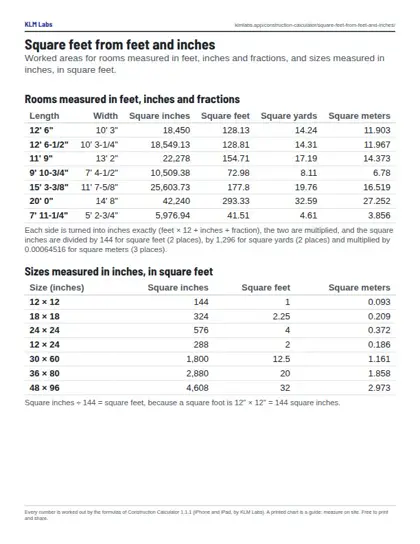
 The numbers come from the Construction Calculator app
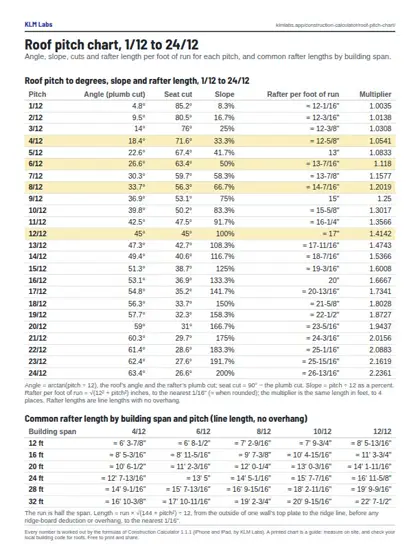 Printable chart


What is a 4/12 roof pitch?
It rises 4" per foot of run: an angle of 18.4° and a 33.3% slope. Each foot of run takes about 12-5/8" of rafter, a multiplier of 1.0541.
What is a 6/12 roof pitch?
It rises 6" per foot of run: an angle of 26.6° and a 50% slope. Each foot of run takes about 13-7/16" of rafter, a multiplier of 1.118.
What’s a normal pitch for a roof?
There isn’t one. The code sets only the lowest pitch for each roofing:
| Roofing | Lowest pitch |
|---|---|
| Mineral-surfaced roll roofing | 1/12 |
| Asphalt shingles | 2/12, with double underlayment up to 4/12 |
| Clay and concrete tile | 2-1/2/12, with double underlayment up to 4/12 |
| Metal roof shingles | 3/12 |
| Wood shingles and shakes | 3/12 |
| Slate | 4/12 |
From the 2021 IRC, R905. Check your local code and the roofing maker’s instructions.
How do I turn pitch into degrees?
Find your pitch in the chart: 8/12 is 33.7° and a 66.7% slope. Its multiplier is 1.2019, about 14-7/16" of rafter per foot of run.
How do I work out rafter length?
Multiply the run (half the span) by the multiplier. A 24' span at 6/12 is a 12' run: 12 × 1.118 is 13.42 ft, about 13' 5". That is the length to the center of the ridge.
Then take off half the ridge board’s thickness, measured level. For a 1-1/2" ridge, that is 3/4" off the run, about 13/16" along a 6/12 rafter.
Rafter size comes from your code’s span tables, not the pitch.
What angle are the plumb and seat cuts?
The plumb cut at the ridge is the roof’s angle. The seat cut on the wall is 90° minus that. At 6/12 they are 26.6° and 63.4°; at 12/12 both are 45°.